

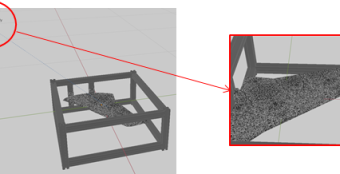
Preparation of your Digital Image Correlation test with Blender
This article invites you to care about an unexpected topic: the preparation of a digital image correlation test with Blender. While research articles do not always mention this aspect of digital image correlation measurements, test preparation is a crucial step in the procedure. The aim is to ensure that the images that will be taken…
Simulation validation with EikoTwin DIC
Simulation validation with EikoTwin DIC relies heavily on image processing. Image analysis methods provide full-field test data that can be used to validate and improve your simulation. Using the unique “Model-Based testing” method, EikoTwin DIC allows measuring displacements and strains of the observed parts directly on the simulation mesh. Thus, you will be able to…
Measurement errors and digital image correlation
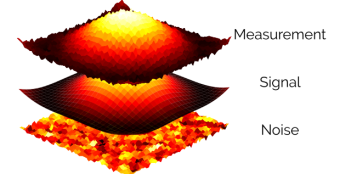
By Pierre Baudoin, R&D engineer at EikoSim When conducting a test campaign instrumented by digital image correlation, it must be possible to determine the characteristic measurement error for the quantities of interest studied (measured displacement or strain). This analysis is essential to know whether the measurement made is indeed the desired “signal” and not the…
What are good Digital Image Correlation test practices?
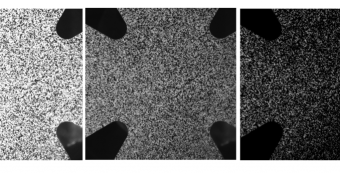
Importance of a good implementation of digital image correlation tests When performing a test by using Digital Image Correlation (DIC), many parameters must be taken into account: brightness, speckle pattern, camera placement. All these steps are essential to achieve the best possible images, in order to get the maximum information from them. Indeed, neglecting one…
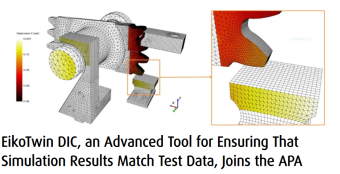
EikoSim Joins the Altair Partner Alliance to Increase Its Footprint Among Simulation Customers
By Florent Mathieu, Ceo of EikoSim EikoSim today announced that it has become a member of the Altair Partner Alliance (APA), to provide its image analysis and simulation validation tools to Altair simulation software customers. This partnership came together after EikoSim’s efforts to develop compatibility between its EikoTwin software and Altair’s simulation suite, giving Altair customers…
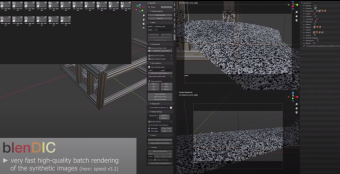
EikoTwin Virtual: a support tool for the preparation of your virtual tests with Blender
The first stable version of the blenDIC add-on has been released. It is a photo-realistic image generation tool for setting up and performing virtual tests involving digital image correlation using the open source 3D animation software Blender. BlenDIC is an open source (GPL) add-on to Blender that encapsulates a large number of tools allowing Blender…
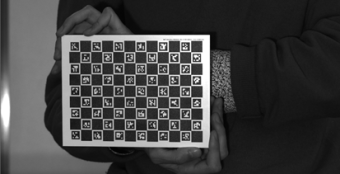
Hybrid calibration: a robust alternative to self-calibration
Introduction This article is written as a complement to the article on good calibration practices recently published on our website. In general, it is very often possible to calibrate the camera system in EikoTwin DIC thanks to the knowledge of the geometry of the part, and of the correspondence between points of the model and…
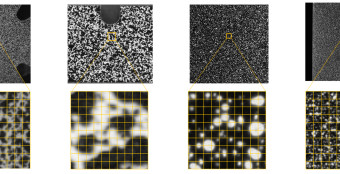
Speckle pattern size: how to calculate it for your DIC test?
In a previous article, we discussed how to choose the size of the speckle pattern for your experiment. We introduced the necessary parameters to control in order to optimize the size of your speckle for each of your tests. As mentioned, although the quality of a speckle pattern can only be analysed with respect to…
Design and validation of laser impact tests
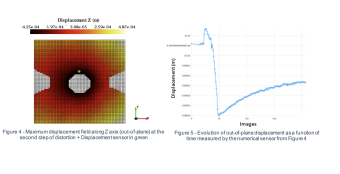
ALPhANOV, an optics and lasers technology center based in Talence since 2007, and MBDA, the European leader in the Defence sector, have had a joint laboratory since 2019 for laser-matter interaction comprised of a cabin equipped with a high-power infra-red source. Thanks to a flexible and durable architecture, complex experiments, quickly reconfigurable, highly instrumented, and…
High-temperature tests for ceramic matrix composites
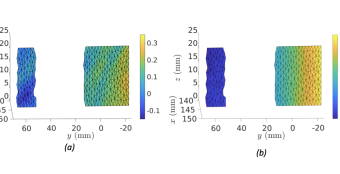
As a new member of EikoSim team, I was offered the opportunity to present an overlook of my thesis work dealing with high-temperature experiments for SiC/SiC composites, which was carried out in LMT under the supervision of F. Hild and in collaboration with Safran Ceramics under the supervision of V. Herb and B. Lacombe. Credits…
Follow us !

98-100 AVENUE ARISTIDE BRIAND
92120 MONTROUGE
FRANCE