

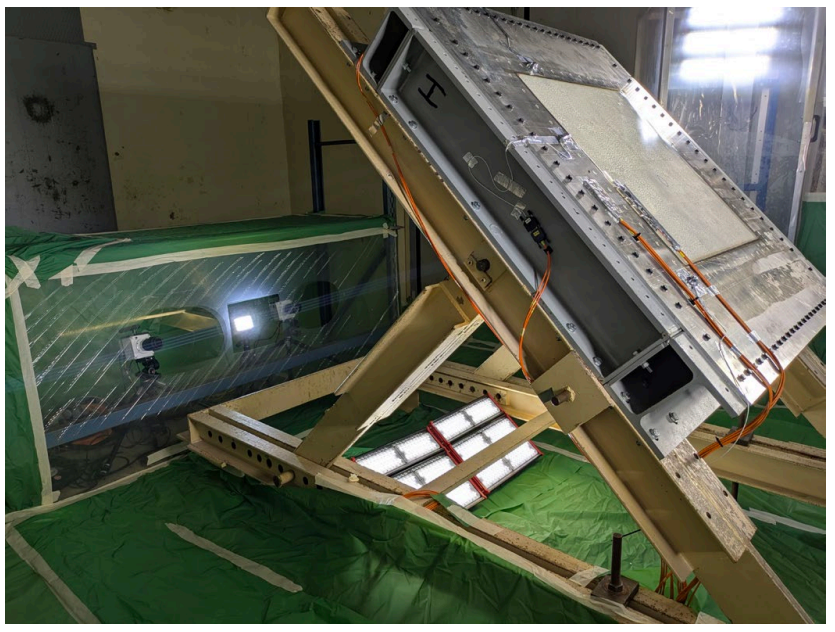
Dynamic testing sits at the intersection of what's hardest to simulate and hardest to measure. Whether you're running an impact test on a composite panel, characterising the modal response of a complex assembly, or validating an explicit FEA model against a real crash event, the challenge is the same: the physics happens fast, the deformation fields are spatially complex, and a handful of accelerometers or strain gauges will never tell the full story.
FAQ
-
What acquisition rates are available for impact testing? EikoCam systems support up to 170 Hz full-frame with the V2 configuration, and up to 360 Hz at reduced resolution. For very high-speed events (crash, explosive decompression), custom designs are preferred. EikoSim can help select the right configuration based on the event duration and the strain gradients expected.
-
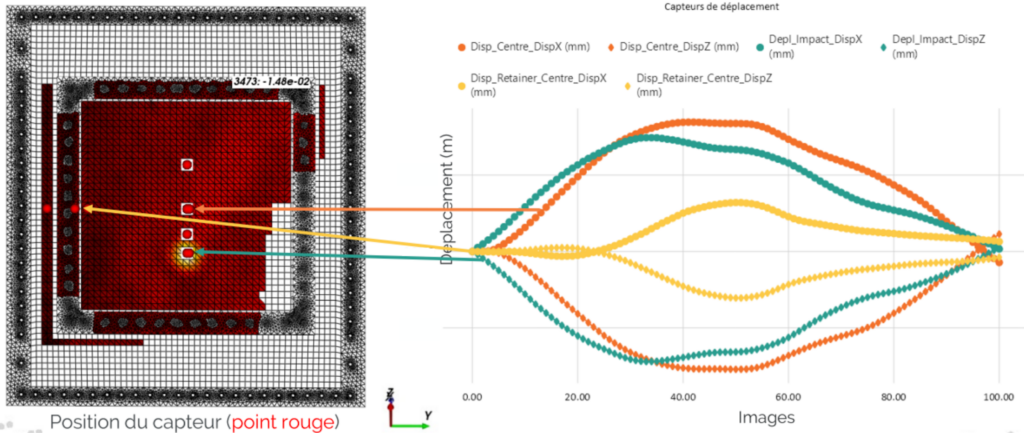
Can EikoTwin DIC measure operational deflection shapes and mode shapes? Yes. EikoTwin DIC processes image sequences to extract displacement fields at each time step, which can then be used to compute operational deflection shapes across the full surface of the structure. These can be directly compared to FE-predicted mode shapes at the mesh nodes.
-
How does full-field DIC compare to accelerometer grids for modal analysis? Accelerometers provide high temporal resolution at a limited number of points. EikoTwin DIC provides spatially continuous data across the entire visible surface, at the cost of lower temporal resolution. The two approaches are complementary: DIC reveals the full spatial distribution of the response, while accelerometers capture the time history at critical locations.
-
Does EikoTwin DIC require synchronisation with the test instrumentation? Synchronisation improves data quality for dynamic tests, particularly for impact events where the timing between loading and image acquisition matters. EikoSim can advise on acquisition setup and trigger configuration. For modal analysis under harmonic or broadband excitation, synchronisation requirements are typically less stringent.
Our use cases


98-100 AVENUE ARISTIDE BRIAND
92120 MONTROUGE
FRANCE