

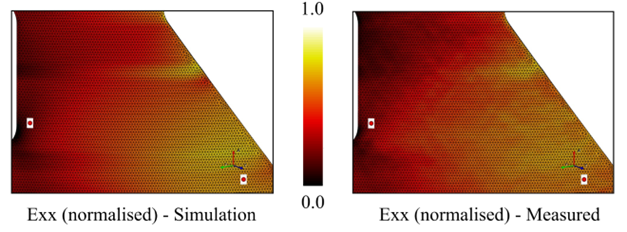
Every FEA model rests on assumptions: boundary conditions that are idealized, material parameters that are estimated, contact definitions that are simplified. These assumptions are invisible until something fails in the test — or worse, in the field. FEA model validation exists to catch the gap between model and reality before that happens.
FAQ
- What types of loading can EikoTwin DIC validate?
Static, quasi-static, dynamic, modal, thermal, and thermo-mechanical loading. The software supports single-frame and time-series analysis, including batch processing of large image sequences. - How do I align my simulation results with the DIC measurements?
Because EikoTwin DIC calibrates the camera system directly on the FE mesh geometry, measurement and simulation results are already in the same coordinate system. No manual alignment or interpolation is required. - What if my model diverges from the measurements?
EikoTwin Digital Twin, the model calibration module, allows you to update boundary conditions, material parameters, or contact definitions based on full-field experimental data. The process is iterative and can be automated for large parameter spaces.
- Can I use EikoTwin DIC for certification-level validation?
Yes. EikoTwin DIC has been used in R&D projects with Ariane Group and in industrial qualification workflows in aerospace and automotive contexts. The quantitative, full-field nature of the data makes it well-suited for supporting certification arguments.
Our use cases

98-100 AVENUE ARISTIDE BRIAND
92120 MONTROUGE
FRANCE