
Crack propagation is one of the most demanding validation challenges in structural engineering. Whether you're working on composite materials, metallic structures, or bonded joints, understanding *where* a crack initiates, *how* it propagates, and *why* your simulation diverges from reality requires full-field measurement data — not just a handful of strain gauges.
FAQ
- What loading conditions can EikoTwin DIC handle for crack propagation?
EikoTwin DIC works with static, quasi-static, and high-speed dynamic loading. The software supports image series batch processing, so you can track crack propagation across hundreds of load steps without manual intervention. - Can I extract stress intensity factors (SIF) directly from EikoTwin DIC?
Yes, although indirectly. Because displacement fields are measured directly on the FE mesh, post-processing scripts can compute fracture mechanics parameters — including SIFs — from the full-field data. EikoSim can support custom post-processing development for specific needs. - Does EikoTwin DIC work on geometrically complex specimens?
Yes. EikoTwin DIC has been validated on parts with analysis areas as small as 2 mm in section. The FE mesh-based calibration handles complex geometries that would be difficult or impossible to address with traditional DIC approaches. - How does this compare to traditional DIC for crack propagation?
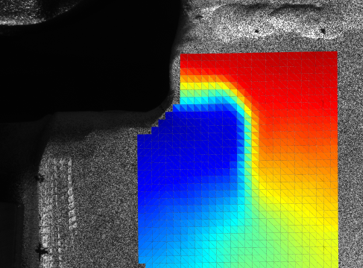
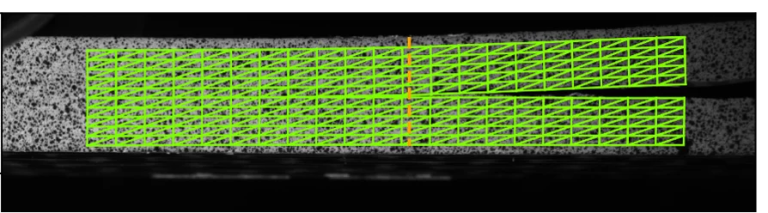
Traditional DIC produces a point cloud that must be manually aligned with simulation results — a process that introduces interpolation errors and costs significant engineering time. EikoTwin DIC measures *on* the mesh, making test-simulation comparison immediate and quantitative.
Our use cases

98-100 AVENUE ARISTIDE BRIAND
92120 MONTROUGE
FRANCE