


Design and validation of laser impact tests
ALPhANOV, an optics and lasers technology center based in Talence since 2007, and MBDA, the European leader in the Defence sector, have had a joint laboratory since 2019 for laser-matter interaction comprised of a cabin equipped with a high-power infra-red source. Thanks to a flexible and durable architecture, complex experiments, quickly reconfigurable, highly instrumented, and…

High-temperature tests for ceramic matrix composites
As a new member of EikoSim team, I was offered the opportunity to present an overlook of my thesis work dealing with high-temperature experiments for SiC/SiC composites, which was carried out in LMT under the supervision of F. Hild and in collaboration with Safran Ceramics under the supervision of V. Herb and B. Lacombe. Credits…
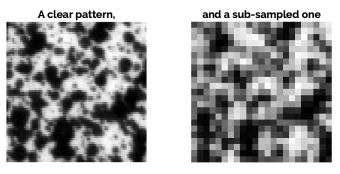
What is a good dic speckle pattern?
Concerned about making a new speckle pattern for your DIC experiment? In another article, we talked about the different techniques for creating a speckle pattern in digital image correlation, including the ability to vary the size and nature of the spots projected on the piece. But what size should your speckle pattern be? There is…

Detection monitoring of cracks with Digital Image Correlation: a choice tool
Context Some structures have a long service life from commissioning to replacement. These structures, when they have a fundamental role, must be able to maintain their physical integrity throughout their service life. To do this, it is essential to ensure their reliability over time. In the case of such structures as metal water pipes, different…
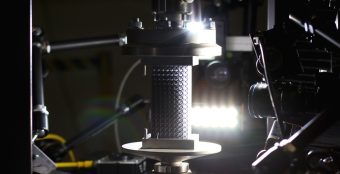
Digital Image Correlation for lattice structures
Why use Digital Image Correlation when testing lattice structures? This is what this article is about. Interest in lattice structures is growing rapidly for the development of aeronautical and space components in particular. In addition to the significant mass gains they allow to consider, they offer the possibility of optimising their behaviour based on their…
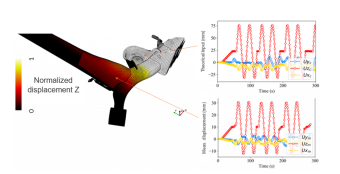
Digital Image Correlation for production monitoring – a collaboration with Renault and CETIM
Context As part of the large-scale production monitoring of automotive parts, it is essential to ensure that the reliability of the manufactured parts remains constant throughout the part’s production cycle. In order to make sure of this, parts are regularly sampled from production lines and tested to ensure that they still meet the required safety…
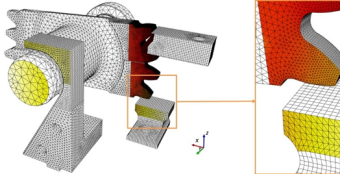
Validation of a mechanical test – a collaboration with MCE-5 DEVELOPMENT and MECATEST
EikoTwin DIC to validate your test kinematics, with MCE-5 DEVELOPMENT and MECATEST The purpose of a mechanical test is to submit a part or an assembly of parts to a specific stress in order to evaluate its elementary or in-service performances. The strong hypothesis, strengthened by theory or numerical simulation, is that the test bench…
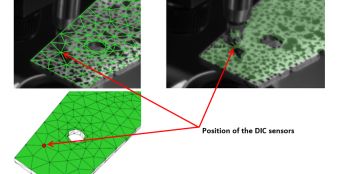
Verification of the robustness of an Image Correlation software – a collaboration with SAMWELL Testing Inc.
The quality of displacement fields measurements using digital image correlation depends on many factors which can be: In order to validate the robustness of a digital image correlation software algorithm, it is interesting to compare the results of the software with other reference measurements obtained independently but under identical test conditions (same external factors to…
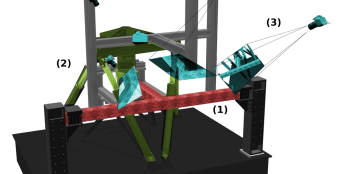
Previsualization with Blender of a complex structural test
Written by Matthieu Vitse Matthieu Vitse is a freelance scientific visualization expert. He has a PhD in computational mechanics from ENS Paris-Saclay, and his main activity now focuses on the post-treatment and visualization of large complex data simulations and experiments. More info at www.sciviz.fr (from Vitse et al. Toward virtual design and optimization of a…
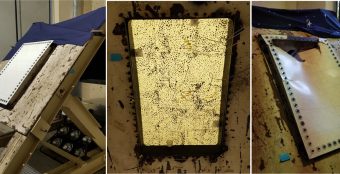
Toward quantitative image analysis of Bird strike tests
Redactors : N. Cordero, F. Fremy, M.Beneck for Saint-Gobain, F. Mathieu for EikoSim Aircraft radomes produced by Saint-Gobain are made of composite materials. In addition to the usual design requirements that these structures must comply with (lightness, aerodynamic shape, impact resistance), they need to be RF transparent so that the systems they shelter may function. This…
Follow us !

98-100 AVENUE ARISTIDE BRIAND
92120 MONTROUGE
FRANCE