

Advantages of imaging-based structural test instrumentation
- By Florent Mathieu, President & co-founder of EikoSim
It is fairly easy to understand the technical value of measurement by digital image correlation. For the test engineer, it makes it possible to measure over a wider area, to better understand the physical phenomena at play, and to perform a non-contact measurement. The simulation engineer, for their part, can update the simulation model against a more complete data set, and thereby improve its predictive capability, as can be seen for example in the Alstom bogie test that we have already discussed from a technical standpoint.
But just how much can instrumentation contribute to such a structural test? Is building up skills in a new technique worthwhile from a financial point of view? EikoSim guides you through the main areas where improvements are possible.
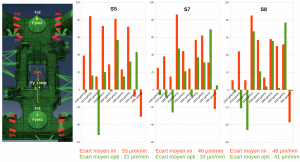
During the test: sources of savings
One of the first things a digital image correlation user wants to do is to do away with strain gauges. Time-consuming to install and costly (a figure of €100 per bonded gauge is often quoted), physical strain gauges can thus be replaced by virtual strain gauges, at least over the usual measurement range of digital image correlation (strain level at least above 0.01%).
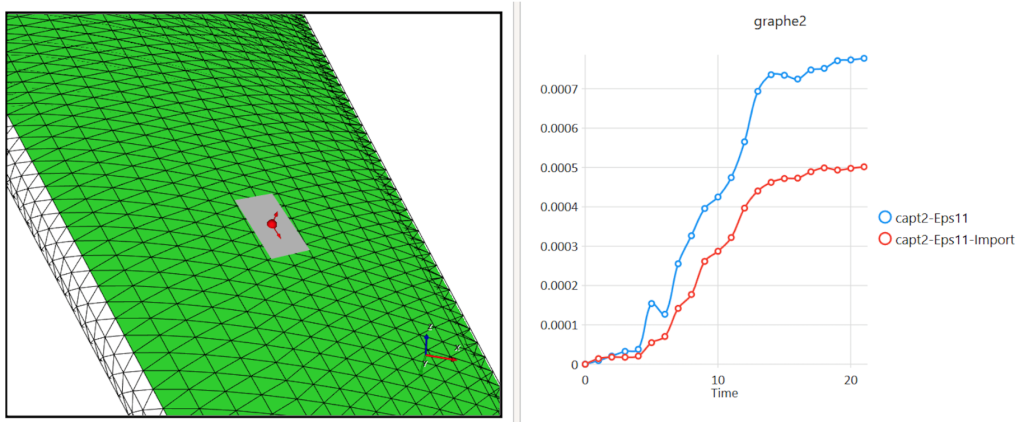
In the bogie example, taking into account the few areas not accessible by imaging, we estimate that we can replace no fewer than 50% of the gauges with 4 cameras set up in a single day. In this case this represents around €5,000 in savings for the 100 gauges used in the test, without even accounting for the time saved on defining the instrumentation plan. The bogie would also have been available sooner for the test, since such instrumentation very often takes several weeks. Finally, one must also factor in the wasted cost of faulty gauge channels (debonding, electrical issues), affecting roughly 5% of the gauges bonded for this bogie. All in all, nearly €10,000 in savings can be tallied for this test.
On the simulation side: a predictive model sooner
Validating a simulation model against test results often takes time, mostly to extract the simulation results at the locations where the measurement was taken. Beyond the uncertainties tied to these operations (was the gauge really where I placed it in the simulation?), they consume an enormous amount of time, since they must be repeated for every sensor used in the test.
Having a measurement of displacements and strains on the mesh therefore makes it possible to automate and streamline these operations, since the extraction is done at the same points, and it allows the model error to be computed, which can then be reduced. In the bogie case, 2 days of engineering time can be saved immediately on the post-processing of the measurement results alone.
To update the simulation, the engineer must then find the right set of parameters so that the simulation matches the measurement: boundary conditions, material parameters, interface parameters, and so on. Trial and error is the rule here, with the user’s experience as the only guide.
Having the model error, and moreover over a full field, makes sensitivity calculations on each of the parameters far more valuable: one is then able to distinguish which part of the model error is due to a poor estimate of a material parameter or of the orientation of a boundary condition. If the identification process is taken all the way to automation, 3 days can be saved, not counting the quality gains tied to the reduction of the model error.
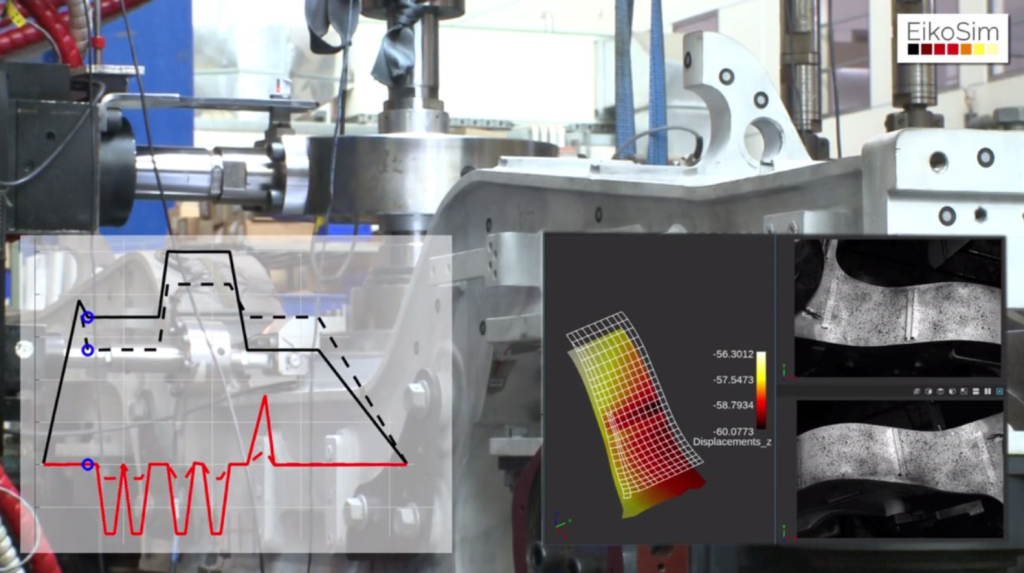
Finally, having rich measurements such as imaging-based measurements makes it possible to improve the simulation more directly: from the measurements one can create measured boundary conditions, which replace the “ideal” (or rather idealized) boundary conditions of the first simulation. These elements are often the source of many questions after the test, so this is a way to remove those points of uncertainty by directly applying real-world conditions to the simulation. The gain here is hard to estimate; let’s just say it is the price of peace of mind!
📖 This article is part of our Complete Guide to Digital Image Correlation.

98-100 AVENUE ARISTIDE BRIAND
92120 MONTROUGE
FRANCE