

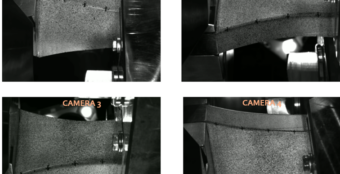
Multi-camera DIC and model calibration of a turbine blade – A collaboration between Safran, EikoSim and Ansys
This article presents a multi-camera DIC instrumentation approach developed as part of a collaboration between Safran Group, EikoSim and Ansys. As part of the development of ever more high-performance aerospace components, the validation of simulation models is a crucial step in ensuring the reliability of designs. This is particularly true for parts subjected to complex…

Local DIC or Global DIC: Which is the Best Method for Your Application?
Introduction Digital Image Correlation (DIC) relies on two main algorithmic families: local DIC (or subset-based) and global DIC (or FE-based). Both approaches produce displacement and strain fields, but their internal workings, strengths, and limitations can be different. First, it is important to note that in 90% of cases, the results of the two methods are…

EikoTwin DIC Python API demo
We are pleased to present our new Python API, designed to facilitate integration and automation of analyses with EikoTwin DIC. This API allows users to take full advantage of digital image correlation (DIC) results with customised post-processing. Its goal is to simplify our users’ workflows by providing a flexible and powerful interface for interacting with…
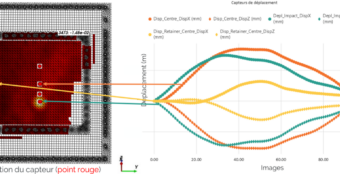
FEA Model Validation with DIC — Bird Strike Impact Testing
In the aerospace and automotive industries, the resistance of structures to various high-speed threats is a guarantee of certifiability. In aerospace, certification for bird strike is a major issue for the safety and certification of equipment and systems. Tests are carried out not only to assess the structural integrity of materials, but also to validate…
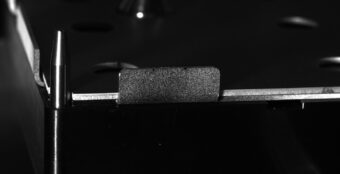
Forming and DIC: measurement of large deformations
Experimental validation of forming processes, such as crimping, requires accurate characterization of local deformation fields, which can be achieved using DIC. A recent measurement campaign was conducted on an industrial part with severe geometric constraints, with an analysis area located on a section approximately 2 mm thick. Beyond the small size of the area of…
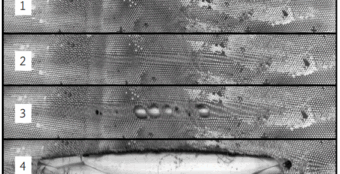
High-Speed DIC — Full-Field Measurement of Airbag Deployment
This article showcases a use of high-speed DIC for validating the behavior of a dashboard opening. Passenger safety is a top priority in the automotive industry. In the event of a collision, the airbag must deploy quickly and effectively to protect the vehicle’s occupants. However, this ultra-fast process is directly influenced by the structure and…

Modal analysis validation – in practice
In a recent post, we mentioned how DIC can be used for modal analysis validation by comparing the measured field with a finite element simulation. A practical exercise was proposed to us by INTES: how to export results to a simulation pre-post, in this case that of the PERMAS software? In this case, we have…

Building simulation credibility: the validation of Ariane 6’s Dual Launch Structure
Ensuring the credibility of simulation models is a concern in all fields of engineering. In aerospace engineering, structural qualification is a crucial step in ensuring that critical components are capable of withstanding the most severe operational conditions. This process is essential to ensure the safety and reliability of systems during missions. This article focuses on…
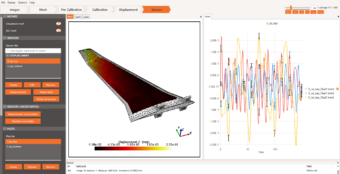
Modal analysis: how can Digital Image Correlation (DIC) help?
Modal analysis is a key technique used in engineering to understand the vibratory behavior of mechanical structures. It enables us to determine the natural frequencies and modal shapes of a structure, which are crucial in ensuring that it does not resonate dangerously under specific operating conditions. Traditionally, this analysis has relied on the use of…

Crash-test and image correlation: how to measure seat deformations and follow the dummy’s movements
Crash tests are crucial in developing and certifying products, especially for the automotive, aeronautical, and railway industries. These tests simulate collision or impact scenarios in order to evaluate the resistance and safety of products. Among the equipment used to perform these tests is the reverse catapult, which is a device that projects an object, in…
Follow us !

98-100 AVENUE ARISTIDE BRIAND
92120 MONTROUGE
FRANCE