


Virtual test set-up

DIC systems
FE-based Digital Image Correlation
Model-based image
processing

Simulation
correlation
DIC Software for FEA Simulation Validation
EikoTwin DIC is a digital image correlation (DIC) software program and system that links measurements and numerical simulations.
It uses a patented Digital Image Correlation technology to provide automatic test-simulation comparison.
It allows the efficient determination of model errors and the identification and resolution of error sources. EikoTwin is the only global FE-based digital image correlation software package built with simulation validation in mind.

EikoSim's engineering partners and customers







EikoTwin DIC is available on the Altair Partner Alliance Platform
Principle
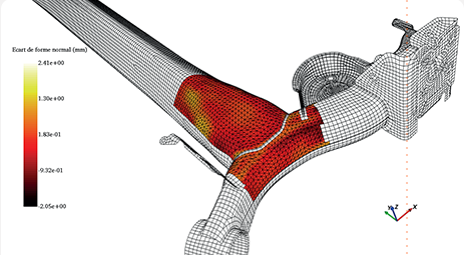
- Image processing (digital image correlation) based on the finite element mesh.
- Automatic calibration around the mesh.
- Multi-view (no technical limit to the number of cameras).
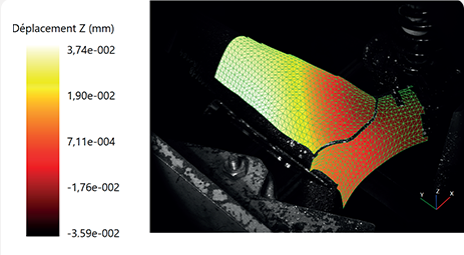
Features
- Many directly accessible fields: displacements, strains, residual (at pixel scale) on the surface of the part.
- Export of figures that can be used directly in your presentation.
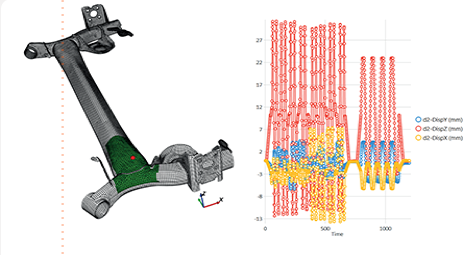
Results
- Virtual sensors (displacement, strain gauges).
- Immediate test/simulation comparison based on finite element simulation results.
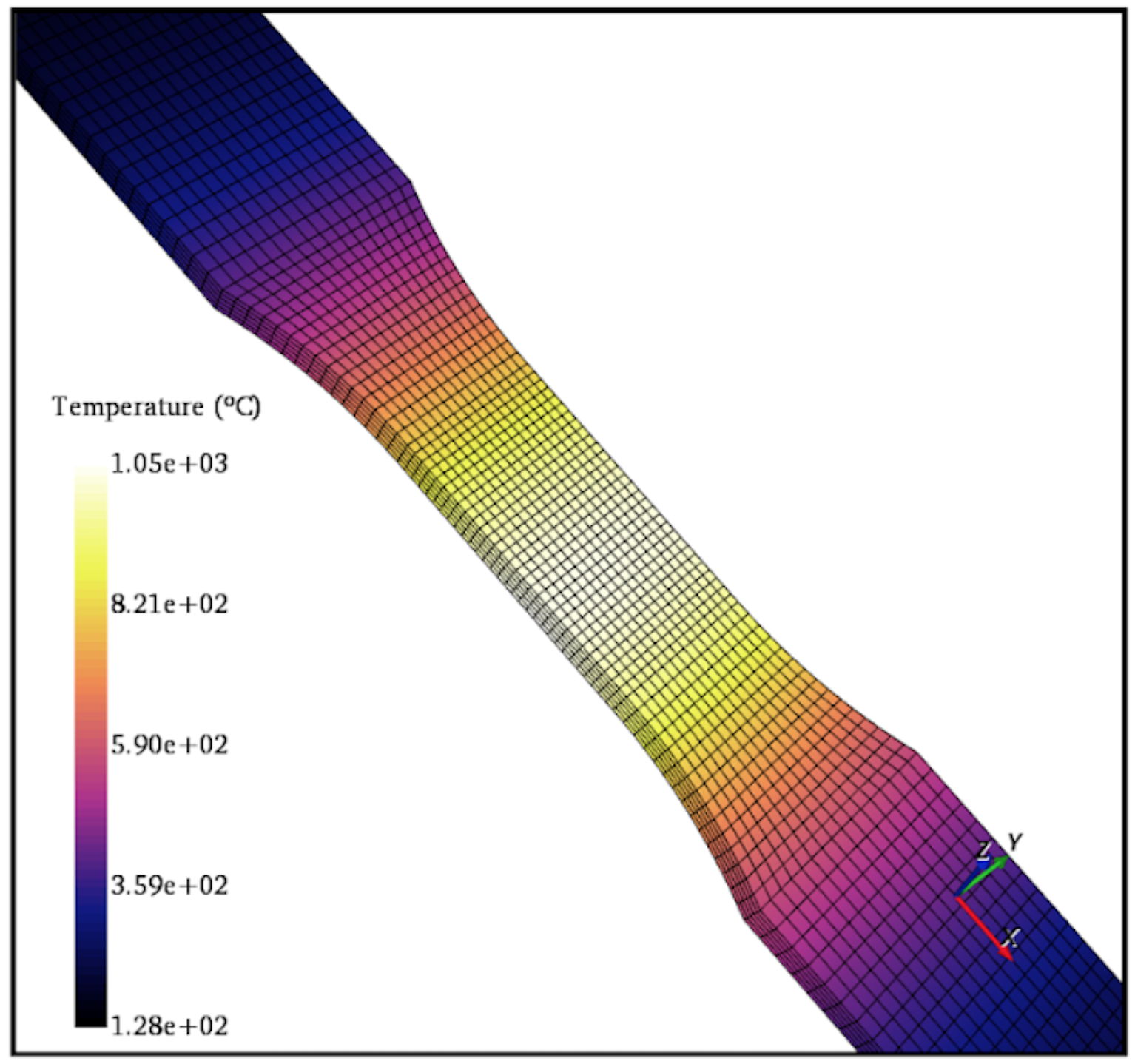
"Thermal" plug-in
- This add-on to EikoTwin DIC bridges the gap between kinematic measurements and infrared thermography.
- Image acquisition: Import infrared images directly into your digital model.
- Correlate the results with your thermomechanical simulation.
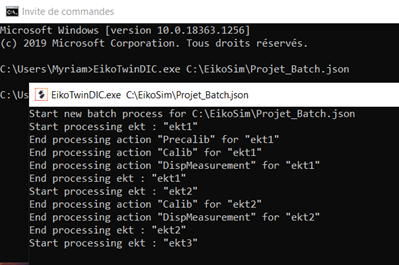
"Batch mode" plug-in
- This tool multiplies the power of EikoTwin DIC by allowing batch processing of image series.
- Process all your measurements in a batch process and increase the value you get from EikoTwin DIC.
Feature demos
FE compatibility
Multi-camera measurements
- Use all of your cameras within the same reference system - and the right one
Measure close to the edge
- Obtain a measurement up until the edge of your specimen thanks to mesh-based DIC
Thermal coupling
- Combine DIC with an infrared camera: temperature is mapped onto the same mesh as your displacements.
HyperWorks integration
- Go from OptiStruct, HyperMesh and HyperView to EikoTwin DIC without breaking your simulation workflow.
Automate with Python
- Script your analyses with the Python API — here, automated crack propagation tracking.
Testimonials




FAQ
What is the difference between EikoTwin DIC and GOM Correlate?
EikoTwin DIC is the only DIC software natively built on finite element meshes, designed specifically for FEA simulation validation. GOM Correlate is a general-purpose metrology tool without native FEA solver connectivity. EikoTwin DIC eliminates the error-prone projection step of point cloud data onto FE meshes. Learn more in our local vs global DIC comparison.
Can I use EikoTwin DIC without an FEA mesh?
Yes. EikoTwin DIC includes a built-in automatic mesher that generates a mesh directly from your images, without requiring an existing numerical model. This is particularly useful for material testing and specimens with simple geometry.
Can EikoTwin DIC be used for material characterisation?
Yes. Combined with EikoTwin Digital Twin, EikoTwin DIC enables automated material parameter identification - including elastic moduli, plasticity parameters (e.g. Johnson-Cook) and composite behaviour - by fitting simulation models to full-field experimental measurements.
Can EikoTwin DIC be used for high-speed testing?
Yes. EikoTwin DIC is compatible with high-speed cameras and can process image series acquired at several thousand frames per second. It has been used notably to measure airbag deployment during dynamic impact tests. See the application: high-speed DIC for airbag deployment.
What FEA solvers are compatible with EikoTwin DIC?
EikoTwin DIC is compatible with all major FEA solvers: Abaqus (.odb), Ansys, HyperWorks (Altair), PERMAS (INTES) and MSC Nastran. It is also available through the Altair Partner Alliance for HyperWorks users.
Applications and tutorials
Multi-camera DIC and model calibration of a turbine blade – A collaboration between Safran, EikoSim and Ansys
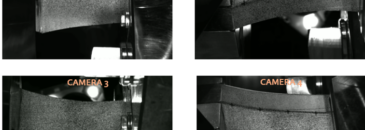
This article presents a multi-camera DIC instrumentation approach developed as part of a collaboration between Safran Group, EikoSim and Ansys. As part of the development of ever more high-performance aerospace components, the validation of simulation models is a crucial step in ensuring the reliability of designs. This is particularly true for parts subjected to complex…
Local DIC or Global DIC: Which is the Best Method for Your Application?
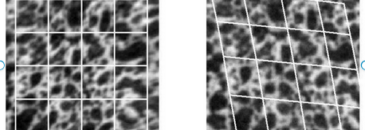
Introduction Digital Image Correlation (DIC) relies on two main algorithmic families: local DIC (or subset-based) and global DIC (or FE-based). Both approaches produce displacement and strain fields, but their internal workings, strengths, and limitations can be different. First, it is important to note that in 90% of cases, the results of the two methods are…
EikoTwin DIC Python API demo
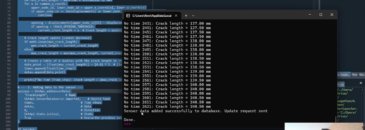
We are pleased to present our new Python API, designed to facilitate integration and automation of analyses with EikoTwin DIC. This API allows users to take full advantage of digital image correlation (DIC) results with customised post-processing. Its goal is to simplify our users’ workflows by providing a flexible and powerful interface for interacting with…
FEA Model Validation with DIC — Bird Strike Impact Testing
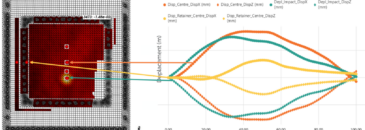
In the aerospace and automotive industries, the resistance of structures to various high-speed threats is a guarantee of certifiability. In aerospace, certification for bird strike is a major issue for the safety and certification of equipment and systems. Tests are carried out not only to assess the structural integrity of materials, but also to validate…
Forming and DIC: measurement of large deformations
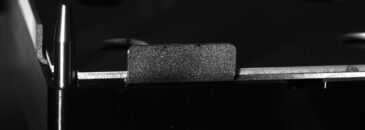
Experimental validation of forming processes, such as crimping, requires accurate characterization of local deformation fields, which can be achieved using DIC. A recent measurement campaign was conducted on an industrial part with severe geometric constraints, with an analysis area located on a section approximately 2 mm thick. Beyond the small size of the area of…
High-Speed DIC — Full-Field Measurement of Airbag Deployment
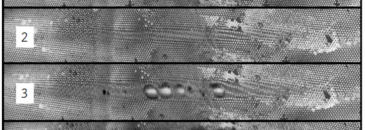
This article showcases a use of high-speed DIC for validating the behavior of a dashboard opening. Passenger safety is a top priority in the automotive industry. In the event of a collision, the airbag must deploy quickly and effectively to protect the vehicle’s occupants. However, this ultra-fast process is directly influenced by the structure and…

98-100 AVENUE ARISTIDE BRIAND
92120 MONTROUGE
FRANCE