

Multi-camera DIC and model calibration of a turbine blade – A collaboration between Safran, EikoSim and Ansys
This article presents a multi-camera DIC instrumentation approach developed as part of a collaboration between Safran Group, EikoSim and Ansys.
As part of the development of ever more high-performance aerospace components, the validation of simulation models is a crucial step in ensuring the reliability of designs. This is particularly true for parts subjected to complex loads, such as the blades of the FAN module, where the accuracy of calculations is vital to ensuring the robustness of materials and structures
Safran, a major player in the aerospace sector, has undertaken an experimental study on a turbine blade root to characterise its mechanical properties under tensile-torsional loading. The objective was twofold: to obtain accurate experimental data and to verify the predictive accuracy of the computational model used for the part’s design. These factors are all the more important given SAFRAN’s use of three-dimensionally reinforced composite materials exhibiting orthotropic behaviour.
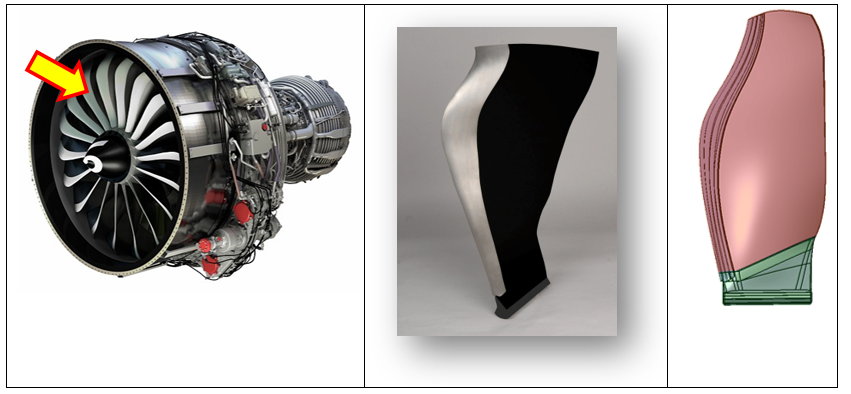
To carry out this study, a close collaboration was established between Safran, EikoSim and Ansys. EikoSim contributed its expertise in test/simulation validation through its software solutions, in particular EikoTwin Virtual and EikoTwin DIC, to optimise the test setup and analyse the experimental measurements. Ansys, for its part, played a key role in integrating the measurement results and calibrating the computational model within Ansys Workbench.
This article provides a detailed account of the methodology adopted, from the virtual preparation of the test through to the calibration of the numerical model, including the analysis of the experimental results.
Mutli-camera DIC test preparation with EikoTwin Virtual
Before carrying out a physical test, thorough preparation is required to optimise the test setup and ensure the quality of the measurements. In the case of the study conducted on a sample of a paddle, this preparation phase was essential due to the complexity of the loading (tension-torsion) and the twisting of the technical specimen, which is not symmetrical, hence the need for a comprehensive measurement of the displacement and deformation fields across all surfaces of the specimen.
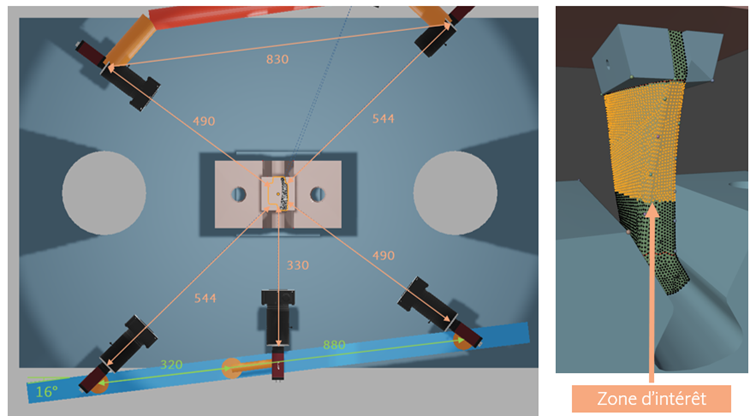
Using EikoTwin Virtual, a digital version of the test was prepared in advance in order to:
- Optimising camera placement: 360° coverage around the test specimen was simulated to ensure that measurements would be comprehensive and accurate.
- Assessing the quality of future multi-camera DIC measurements: the virtual preparation made it possible to verify good visibility of the areas where deformations would be most significant and to estimate a preliminary measurement uncertainty.
- Minimising adjustments during the actual test: by defining the optimal optical settings during the preparation phase, corrections on the test bench were minimised, saving time during instrumentation.
This approach has not only ensured the feasibility of the test, but has also helped to reduce the costs and uncertainties associated with its implementation. The integration of virtual test preparation using EikoTwin Virtual is therefore a key factor in enhancing the reliability of experimental measurements and ensuring an optimal comparison with numerical simulations.
Setting up the test
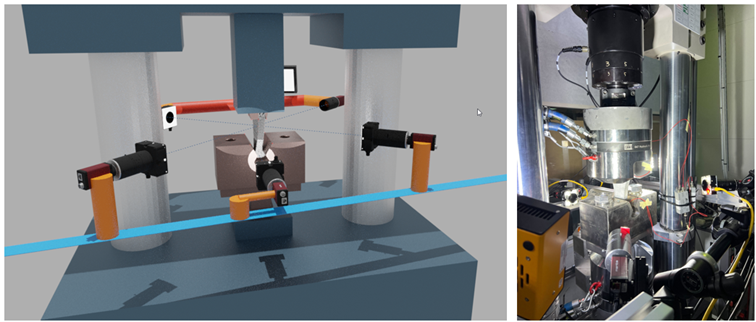
The test specimen consists of a section cut from a blade root, which is subjected to a monotonic load combining tension and torsion. Images are captured every two seconds using the multi-camera system positioned around the test specimen. Real-time monitoring for the first signs of damage is carried out using acoustic emission, in order to halt the test as soon as damage first occurs.
This study aims to address several key issues:
- To understand the complex loading applied to the test specimen and validate the assumptions of the computational model.
- To detect and locate the onset of damage in order to define a first-failure criterion.
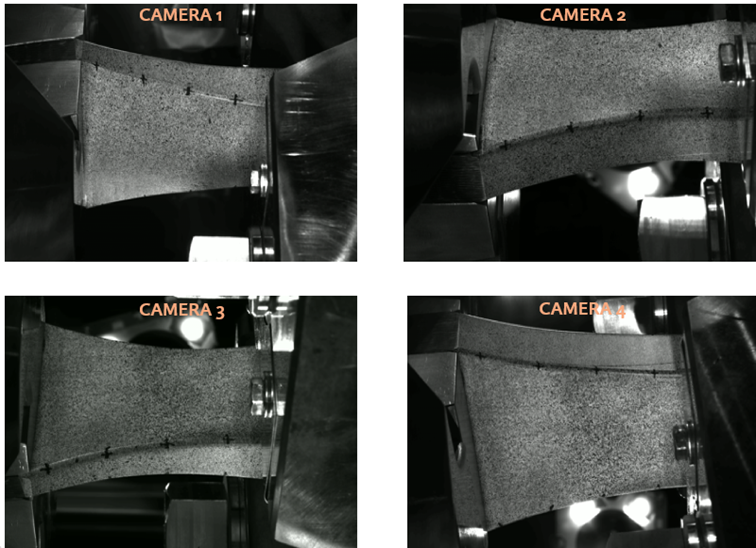
Continuous image acquisition, combined with multi-camera digital image correlation (DIC), enables a detailed analysis of the distribution of strains across the specimen surface. As the test was designed to analyse a complex tensile-torsional loading, it required reliable and detailed data acquisition in order to accurately compare the experimental displacements and strains with the numerical predictions.
Image processing and calculation of strain fields
The acquired images were then analysed using EikoTwin DIC, a digital image correlation software package that allows displacement measurements to be applied directly to the simulation mesh.
This approach has several advantages:
- Direct correlation with the simulation: displacement and strain fields are calculated in the same spatial coordinate system (XYZ) as the finite element simulation, thereby facilitating comparisons (this also applies to the consideration of the local coordinate system within composite elements, particularly for strains and stresses)
- Transient analysis of results: data is available as a function of time, allowing the evolution of loading and deformations to be examined at every moment of the test.
- Selection of key time points: the study focused on a well-defined loading condition, just before the test was stopped, to compare the experimental and numerical results under controlled conditions.
The processed data enables us to obtain:
- Displacement and strain maps showing the distribution of forces across the test specimen.
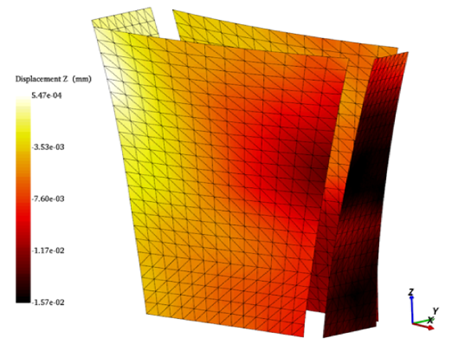
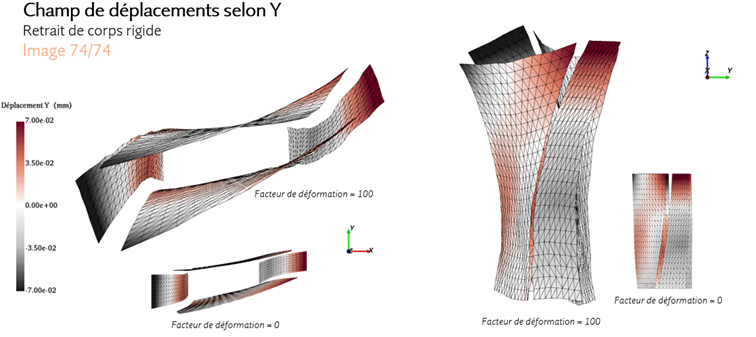
- Plots of the resulting deformations, which can be displayed with a magnification factor to aid in the interpretation of the mechanical phenomena.
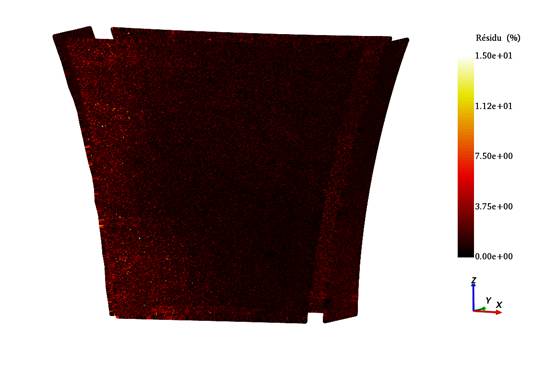
- An analysis of residual correlations, confirming the absence of visible cracks and thereby validating the undamaged region of the test specimen.
All of these results will serve as the basis for the next phase: recalibrating the simulation model using Ansys Workbench.
Collaboration with Ansys and recalibration of the computational model
Once the experimental results had been obtained and analysed, the next step was to compare this data with the numerical simulation and recalibrate the computational model in order to improve its accuracy. This phase was carried out in collaboration with Ansys, by integrating the test results into Ansys Workbench.
To ensure an effective comparison between the test and the simulation, a dedicated script has been developed to make EikoTwin DIC results compatible with Ansys Workbench. This script enables:
- To import the measured displacement fields directly onto the simulation mesh.
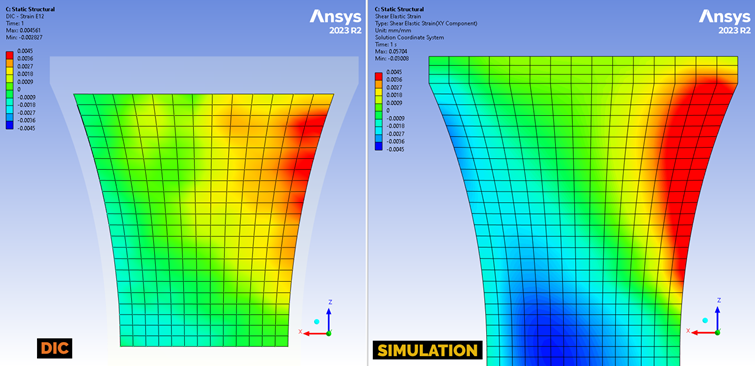
- To visually compare experimental results and numerical predictions on the same coordinate system.
- To analyse the discrepancies between the test and the simulation, in order to identify the necessary adjustments to the model.
Definition and application of boundary conditions
Once the initial comparison had been carried out, it was necessary to adjust the boundary conditions of the model in order to achieve a more accurate fit:
- Recording of the displacements measured at the top and bottom of the test specimen.
- Determination of the actual forces and rotations applied to the test section.
- Application of the boundary conditions derived from the test to the simulation.
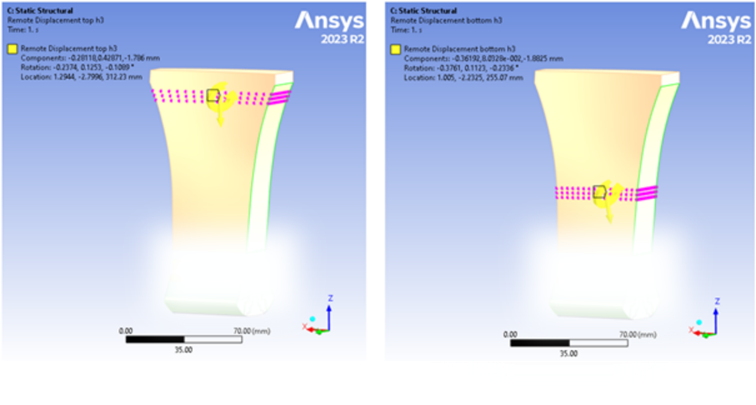
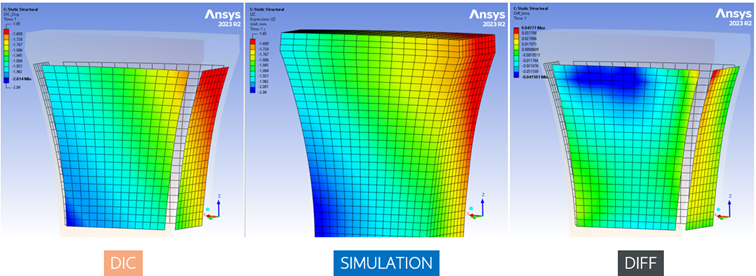
Initially, the approach adopted involved using a global torsion model (6 degrees of freedom: 3 translations and 3 rotations) to impose the boundary conditions. However, this method proved to be too rigid and failed to capture the local deformation effects accurately.
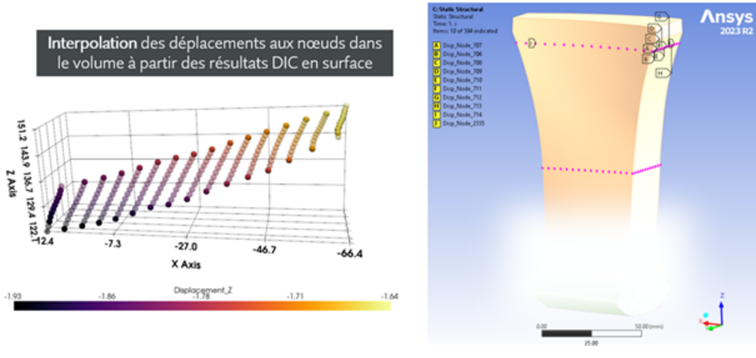
Optimisation of the adjustment using boundary condition interpolation
To improve the accuracy of the re-registration, a more flexible approach has been implemented:
- Interpolation of boundary conditions on the test section based on surface results.
- Better account taken of local deformations to accurately reproduce the mechanical behaviour of the test specimen.
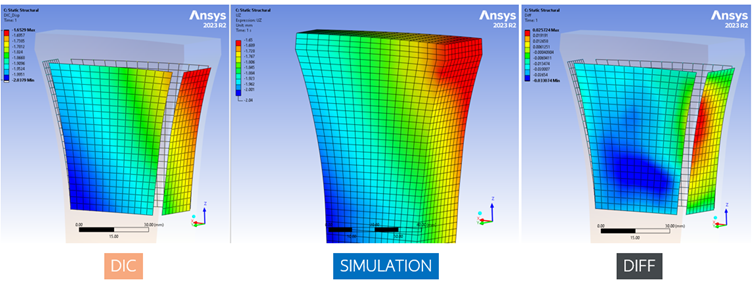
As model recalibration requires significant data processing, the Ansys teams contributed their expertise to improve the script’s efficiency and optimise the integration of results into Workbench. This collaboration made it possible to:
- Reduce the computational complexity of the import and calibration process.
- Speed up the adjustment iterations between testing and simulation.
- Ensure robust comparability between numerical predictions and experimental observations.
Thanks to this approach, the material parameters of the simulation model could be adjusted more precisely, ensuring better prediction of the mechanical behaviour of the blade.
Impact and outlook for Safran
One of the key benefits of this study lies in improving the predictive accuracy of simulation models through the use of highly detailed experimental data. By directly incorporating test results into the validation of the numerical model, it becomes possible to increase confidence in the simulations and gradually reduce reliance on physical testing. Calibrating the model against data derived from detailed measurements allow:
- To improve the predictive accuracy of simulations and gain a better understanding of the mechanical phenomena involved.
- To enhance the reliability of numerical models, which is a key factor in enabling certification by analysis (CbA).
Thanks to these advances, Safran can increase confidence in the results of complex boundary-condition tests, thereby making the use of simulation tools more reliable for technological loading scenarios, optimising the design of its components and reducing the number of costly and time-consuming experimental tests.
Ultimately, by increasing the number of such studies and recalibrations, the aim is to rely increasingly on simulation for the development and optimisation of components, whilst reducing the number of physical tests required. This approach is part of a global trend towards advanced digital methods, where testing is no longer systematically used to validate a design, but rather to consolidate and refine simulation models.
By leveraging solutions such as EikoTwin DIC for multi-camera test analysis and Ansys Workbench for model calibration, Safran is equipping itself with powerful tools to accelerate innovation and ensure the reliability of its design choices. This study thus demonstrates the power of digital tools when integrated into a rigorous engineering process, and highlights the importance of collaboration between manufacturers and test and simulation specialists in meeting the challenges of tomorrow’s aerospace industry.

98-100 AVENUE ARISTIDE BRIAND
92120 MONTROUGE
FRANCE